


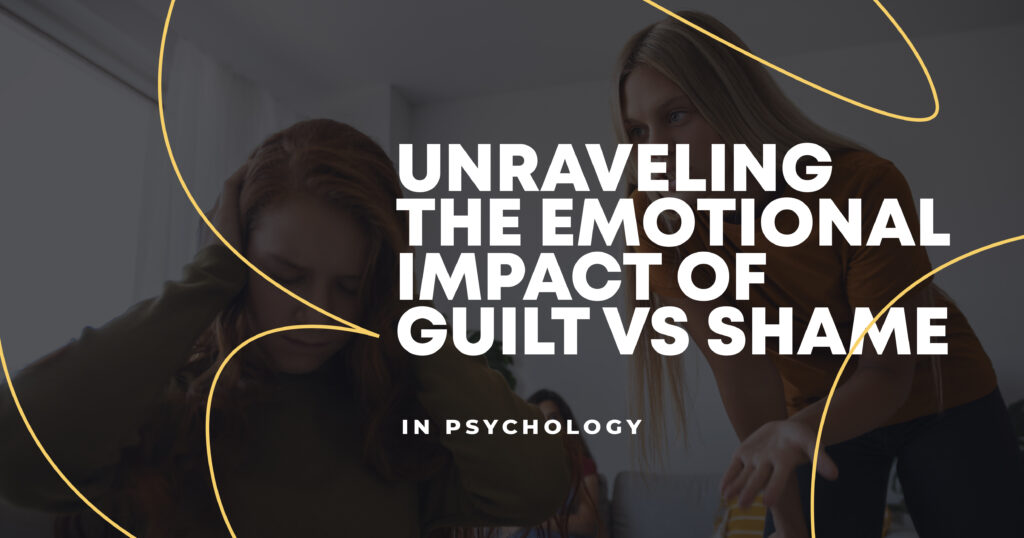
The ability to recognize our emotions is a significant aspect of maintaining a healthy mind. The most ambiguous and misunderstood emotions are guilt vs. shame. These two emotions are usually used interchangeably in daily life – however, psychology has set a separation between the two. It is also possible to learn how to approach emotional situations in a more efficient manner, get better relationships, and self-develop with the help of these differences.
Understanding Guilt and Shame in Psychology
Both guilt and shame are self-conscious feelings that come to mind when we feel that there has been a moral or social wrongdoing. They are self-signals, which cause introspection and encourage rearrangement of behavior. Nevertheless, their psychological causes and consequences do not coincide.
Defining Core Differences Between Guilt and Shame
Simply, guilt is the emotion that develops when one realizes that a particular activity is wrong or damaging. It is strongly linked to behavior and can be a strong inducement to reparative behaviors. Shame, however, is a self-centered emotion as opposed to action. In the event of one feeling shame, they see themselves as being flawed or unworthy at their core.
In simple terms:
- Guilt = “I did something bad.”
- Shame = “I am bad.”
This difference plays a significant role in self-understanding and treatment. Although guilt may contribute to the development of accountability and corrective behavior, shame is likely to trigger withdrawal, self-criticism, and chronic adverse self-image.

Emotional Experiences of Guilt vs Shame
The intensity of emotional responses associated with guilt and shame differs significantly. Guilt often leads to constructive outcomes, such as increased empathy and concern for others, motivating individuals to apologize or make amends. In contrast, shame tends to evoke feelings of worthlessness, anxiety, and even depression, as it targets a person’s core sense of self rather than a specific behavior.
Psychologists observe that guilt may be constructive, which leads to positive changes and agreement. Shame, on the contrary, is usually maladaptive and associated with stop-loss and withdrawal. These differences are important to understand in order to grow personally and manage mentally.
Dr. June Tangney, the foremost researcher on shame and guilt, explains that guilt is equated to recovery and reintegrating the social connections, but shame can be destructively self-centered and destabilizing the relationships (Tangney and Dearing, 2002).
Behavioral and Relational Impacts
Guilt and shame have an impact on behavior and relationships, however, in different ways. Guilt is the motivating factor of prosocial behavior and is the one that spurs reconciliation. It enhances responsibility, and this allows one to be socially healthy.
Shame, in its turn, may also have more harmful effects. Individuals who feel shame will not face the issues, will sever relationships, or even resort to defensive or aggressive behaviors in a bid to manage the pain. In the long run, the shame that goes unresolved may lead to anxiety, depression, and low self-esteem.
Example of Behavioral Differences:
- Guilt. Saying sorry, reconciliation, rectifying errors, and doing restitution on a volunteer basis.
- Shame. Shirking, seclusion, concealment of weaknesses, self-blame.
- Long-Term Impact of Guilt. Improved social relationships, ethical development.
- Long-Term Impact of Shame. Loss of socialization, self-esteem problems, and mental health issues.
Strategies for Healing and Growth
Effective guilt vs. shame therapy focuses on acknowledging emotions without judgment and developing healthier coping strategies. Cognitive-behavioral therapy (CBT) can help individuals identify distorted self-perceptions, reframe negative thoughts, and cultivate self-compassion.
Another effective method is mindfulness-based therapy. The non-judging attitude towards emotions helps people to decrease the levels of shame and have an overview of guilt, and then act before the situation goes out of control, instead of being emotionally frozen.
| Therapeutic Approach | Focus | Benefits |
| Cognitive-Behavioral Therapy (CBT) | Identify negative thought patterns | Reduces self-criticism, promotes constructive change |
| Mindfulness-Based Therapy | Present-moment awareness | Helps regulate emotional responses, lowers shame intensity |
| Compassion-Focused Therapy | Self-compassion & empathy | Encourages forgiveness, reduces chronic shame |
| Psychodynamic Therapy | Explore unconscious patterns | Addresses root causes of shame and guilt |
Useful guides on self-compassion and emotional regulation that could be instrumental in overcoming guilt and shame are offered by the American Psychological Association (APA).
Exploring Deeper Psychological Perspectives
In addition to daily life, there is also existential guilt and shame that psychology regards as a result of the more generalized thoughts concerning life, purpose, and moral responsibility. Existential guilt is the sense that people have lived a false life or not exercised their talents to their utmost capacity, and existential shame is the sense of incompetence regarding their existence or themselves.
All these emotions can be really frustrating, but also offer opportunities of self-reflection and self-development. Dealing with existential guilt and living with shame, individuals will be able to get a better understanding of themselves, clarify their values, and make the changes that may help them to feel a sense of meaning in their lives.
Personalized Support at Shine Mental Health
At Shine Mental Health, we understand how the concepts of guilt and shame differ and have a severe effect on mental health. Our mental health caregivers are very caring and provide individual services as per your experiences. Our evidence-based therapy, mindfulness activities, and warm-hearted guidance allow you to deal with the emotional burden of guilt and shame and develop resilience, self-care, and healthier relationships.
Get help today at Shine Mental Health.

FAQs
What are the core psychological differences between guilt and shame?
Guilt centers on a particular act that is considered to be wrong, whereas shame is centered on the self, and this generates a sense of unworthiness. Such variations affect the emotional reactions, behavior, and relationship processes.
How do feeling guilty and feeling ashamed differ in terms of emotional experiences?
Guilt is known to trigger corrective behavior and empathy, and shame is known to trigger withdrawal, anxiety, and low self-esteem. Guilt is action-based – shame is self-based.
What impact do guilt and shame have on behavior and relationships?
Remorse promotes making restitution and enhancing social cohesion. Shame can lead to avoidance, secrecy, or poor relationships because of poor self-perception, though.
What are effective strategies for overcoming guilt and shame?
Interventions such as CBT, mindfulness, and compassion-focused therapy may be used to redefine or overcome guilt and shame, negative cognition, emotional regulation, and positive reactions to guilt and shame.
How can therapy address the emotional effects of guilt and shame on mental health?
Through therapy, one acquires resources to comprehend feelings, achieve self-understanding, and use adaptive coping mechanisms, diminishing the adverse effects of guilt and shame on general mood.